23 February 2010

chapter three: notes from the story
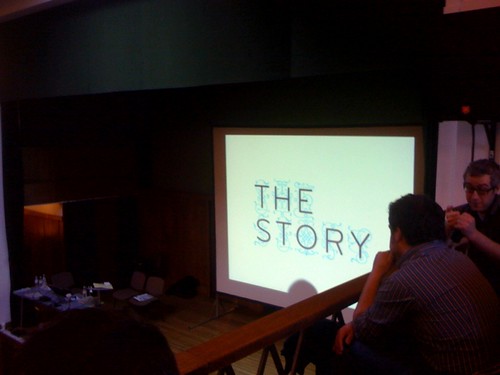
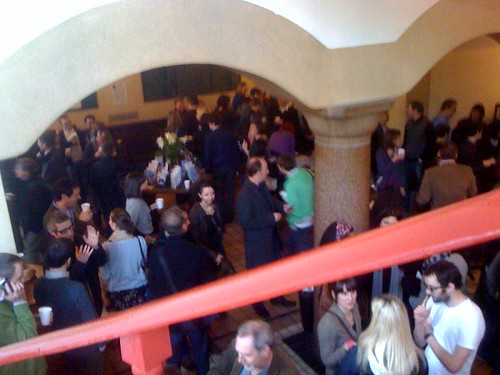
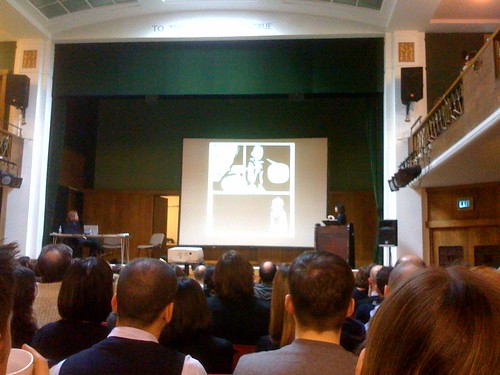
view from the balcony So Matt Locke's The Story happened last week. It was really good. About 400 people filled the Conway Hall to listen to people tell their stories or explain how they tell their stories. Everyone listened and laughed and applauded in the right places. In the breaks everyone filed out and drank lots of coffee. Coffee breaks looked like this, in fact: coffee break But I won't attempt to tell you about the whole day - partly because there was so much on, each talk was so different from the last (and yet the whole thing hung together so well), and partly because my notes and impressions would probably make no sense. In any case, the nature of the day I'd probably have to extrapolate at length to find a "point" where a lot of the time the only point might have been to tell a good story. So I'll concentrate on my highlights instead. Annette Mees and Tassos Stevens of You Have Found Coney told us about their immersive theatre experience, A Small Town Anywhere. "What do you call it?" I wrote in my notebook alongside their names. Alexis Kennedy of Failbetter Games showed us the inner workings of their Echo Bazaar Twitter game. "You need an organising principle" and "Go mad and hallucinate lizards" are a couple of the notes I've put against their talk. That seems to say more than I possibly could. What the Failbetter and Coney chaps have in common is that they are striking a deft balance between the player/participant driving the story and the interventions the storyteller needs to make to get you to where they want you to go. That choose-your-own-adventure, gaming aspect to their storytelling really appeals to me; at once brilliantly nostalgic and yet at the same time feeling a bit like the future of media (and other stuff). Regular readers of this blog will know of my soft spot for comics. So perhaps it's no surprise that Sydney Padua, author of the Lovelace and Babbage web comics was another highlight. Smart but self-effacing, she showed the crowd how she told stories visually as well as verbally. Her slides were great, too. I was too far away to get any real detail on my iPhone in this pic, but at least you can see that everybody's heads were pointed in the right direction. padua slides But my clear favourite was Tim, who read a story about the failure of a marrriage whilst the hero attempts to fool his business partner into thinking a project with Harrison Ford was on the cards. No one seemed able to work out whether it was invented or true, or at least what the balance really was between fact and fiction. Which is exactly how I think the very best stories should be. "Strange synchronicity" and "My moustache is a symbol of my misery" seem to sum it up perfectly, somehow. So I'll leave it there. More eloquent and interesting observations can be found on James Bridle's, Rebecca Denton's, and Vicky Matthews's blogs.
Labels: , , , , , , , , , , ,

3 January 2010

top fives: things i have learned


OK, so I failed to do my last in the top fives mini-series before the end of 2009. Oh well. The moment's probably passed to look at them in great detail but in case you were wondering what they were, here's my list. 1. treat it as a story 2. think of it as a game 3. i need to read faster 4. the agency doesn't always know best 5. do more, read less (as long as you don't read too little) The chances are that I'll be banging on about one or more of these things here very soon anyway.

Labels: , , , ,

9 December 2009

just a little thing

A while ago I entered a postcard writing competition from Leaf Books. My entry didn't win, but turns out they quite liked it. Like lots of things I write for myself, I'm not sure I like it personally. It's a bit overwritten. But should you wish to judge for yourself, it's over here.

Labels: ,

1 November 2009

nanowrimo

I've signed up to NaNoWriMo. Which means I have 50,000 words to write by December. And after just one day, I'm already behind. So embloggening might be a bit sporadic during the month of November.

Labels: ,

18 October 2009

the art of blogging without blogging

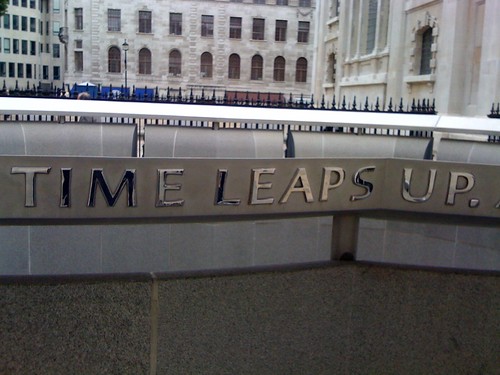
time leaps up While we were in hospital, any spare moments spent fetching coffee or snatching breakfast in the greasy spoon were filled with thoughts of what to blog about, various writing things I'm doing and general ambitions from cleaning the fridge through to getting my Here & There prints framed. Now that I'm back at home I'm behind with all my RSS feeds and everything, work beckons, the house is a bit of a state, and we haven't done nearly enough to get ready for Milo's first birthday party, I still have the burning desire to be productive but seemingly very little time to achieve it in. But then I've noticed that lots of my favourite blogs go through really quiet spells followed by a flurry of publishing. You can almost see the work/life arc behind it. Very few post something every couple of days. I'm not sure how they manage it. Which got me to thinking about the delayed gratification part of continuous partial attention. A lot of the time I click through from iGoogle even if I can't see something has updated, because there's always a bit of a delay before it registers a new post. I'm looking for opportunities to be interrupted. And it's an awesome feeling when I discover that someone cleverer than me has something interesting to say. I like it when someone hits a groove and publishes a load of stuff before going away again for a bit. There's that tension between wanting to be a live node and wanting to save things up, craft them and develop them perfectly. And that kind of thing.

Labels: ,

17 June 2009

the diary vanishes

This is my Haruki Murakami 2009 diary. Tash bought it for me for Christmas last year, because I love Haruki Murakami books. And this is really, really nice. It's designed as a perfect extension to his stuff published by Vintage. It has the same photography and some nice quotes interspersed throughout. But the thing is, I'm rubbish with diaries. I've managed to get key dates in, like birthdays and pay days. But I don't really update it regularly enough with stuff I'm supposed to remember. I'm just too disorganised to make that work. So I was faced with this dilemma of how to use it in a meaningful way, and not waste such a lovely thing. Just recently it came to me to use the diary as a kind of Twitter-ish type thing for flash fiction. Not that it has to stick to 140 characters or anything. But it does have to get used, once a day, to tell a story in the small space defined for me. It doesn't really matter whether they are any good; it's only important to do them. It's a strange kind of discipline that I feel I can stick to. So far.

Labels: ,

24 May 2009

messaging

I brazenly tweeted something about messaging a couple of weeks ago. And, probably rightly, Ian and Will called me out on it. Twitter's not necessarily the best discussion medium and I know this is one of those me-versus-the-world things, so I'll do my best to stumble through an explanation why in this post. Be warned, it probably gets a bit worthy. I sort of have a problem with the word "messaging". There's something about it that makes me want to brush my teeth after I've said it. But I feel perfectly fine about "message" or something much more prosaic and amateurish like "copy" or "the words". I'm not saying those are necessarily viable alternatives or anything. They just sit easier with me. There's a couple of (related?) levels to this I think. The first is purely semantic. Messaging sounds like it was grown in a petri dish somewhere, contrived and grafted onto a piece of visual communication. It's one of those marketing neologisms that just feels too abstracted for my liking. It's not like you'd find one human being passing on "a messaging" to another. It's not The Messaging by Grandmaster Flash and the Furious Five. That would be weird. Whereas message seems a bit more genuine, in a weird kind of way. And the others have a touch of naivety about them. They just feel more human. Of course, whether you call it messaging or a message, it's the same thing. I'm not kidding myself. It's still from a brand to a person, in order to stimulate a purchase or use, or to attempt to ensure loyalty. The only difference is charm, I suppose. Like when planners talk like people and not like a cliche of themselves. Which is the neatest way I can find to bring me on to the other level. Messaging feels a bit like it belongs in the more we speak/you listen, disruptive world of advertising. Not to say the whole disruption thing doesn't still exist. Of course it does, it always will to some greater or lesser extent - it's just that we're better off aiming to engage as well as disrupt. Because there's lots of ways of having a dialogue or other interaction with brands. You don't need me to tell you what they are. But I've still sat at a table in meetings where people say things like, "Then users do a behaviour." Which, while it doesn't entirely preclude conversation, doesn't really feel in the spirit of a value exchange. If you're a brand seeking to join in a conversation I think it benefits you to think as human as possible. You just understand the interestingness or usefulness you bring to people better that way. It doesn't mean your brand is human...but it does mean it's something like aspiring to the quality of a fictional character. For me, if your brand is trying to be as human as possible, the language you use in the planning and making of your product/service/comms really matters, because it reveals how you see your relationship with your consumers. And a trace of that, no matter how small, will be visible in all your public touchpoints. So to think one way and try to talk another doesn't really work. Well, that's how I feel anyway. Down with messaging. Long live the message. Because if The Specials had recorded a song called A Messaging To You Rudy, it would have been rubbish. *shuffles off sheepishly*

Labels: , , , , , ,

19 May 2009

rejection can be a good thing

I got a rejection email today from a literary/art project I've recently discovered. I thought I'd send them a bit of flash fiction I'd recently written, but they (rightly) decided it wasn't right for them on this occasion. Earlier in the year I'd wanted to get more personal writing on the go again. And last month I was dismayed to find out that Wandering Army, one of the online magazines that had accepted a few of my stories in the past, had disappeared. So I didn't mind getting the rejection. Not at all. It just felt great to be trying again. I know it's a good story. Maybe it'll find a home somewhere else, and I will have a look. But the most important thing is that I'm doing something I care about. The other bit of good news is that I've been in touch with Marc, the editor of Wandering Army. He explained that he couldn't bear to watch the site dwindle whilst he did other things, so he did the decent thing and took it offline. And he was even kind enough to send me PDFs of my things that were published. The first page of one is up there at the start of the post, because annoyingly Blogger won't let you attach documents. Better go. I'm off to work on a short story.

Labels:

17 April 2009

oh no...

If you know me, you might also know that I like to write other stuff. Not just copy and little strategy bits. Or presentations and blog posts about comms. But actual stories. Flash fiction, short stories and that sort of business. I haven't written much of this kind of thing in the last year, but up until that point I was doing pretty well with getting published in various places. A lot of them were online places, like online fiction magazines, or the sites that accompany literary journals. But the thing is, lots of those places have slowly ceased to exist. It's happened to the Surgery of Modern Warfare, run by the incredibly talented Amy. This Is It magazine. The Journal of Modern Post edited by Jensen Whelan. A few others. You'll just have to take my word for it, I suppose. And now it's happened to Wandering Army. Or it seems like it. I'm trying to find out. But it's not like I've lost the writing I've done or anything. I've just lost that nice feeling of being able to point someone to these things and say, yeah, I did that. It made it past someone's editorial filter. Which was nice and satisfying. And, in a funny way, I'd have quite liked to have printed the pages off, just to, you know, keep in a drawer somewhere, for posterity. But I didn't get round to it in time. Which is one of the potential effects of distributing bits of yourself around the interwebs I guess. So I'm resolving to start writing more short stories again, because it fulfils a bit of a need in my brain. And also I'm going to get me an internet cupboard. (Thanks to Andrew Coulter Enright for the pic.)

Labels:

13 March 2009

books at my bedside

These are the books sat on my bedside table. I'm sharing because I've just added them to Mike's Bedbooks group on Flickr. The Stuff on Walls is a graffiti thing (obvious, probably). I'm rereading Frankenstein and Watchmen. And, although I've seen Shirky lectures on TED and Youtube, I'd never actually read the man. So I figured it's about time. And the Moomin notebook on the left is there for any inspiring thoughts I might get in the middle of the night. Looking at other images in the group, it stands out that lots of people have so much to read. I'm sure it says something interesting...just not quite sure what that is.

Labels: , , ,

12 March 2009

soft fascination

I never really believed that thing about how you're exposed to 5,000 different brand messages every day. Well, it's not that I disbelieved it exactly, I probably just hadn't thought about it properly. But I've just come back from a short break packed with views like this. And as I unpacked my toothbrush when I got back, I opened my bathroom cabinet and saw this. Then it was time for a late lunch. And when I opened the kitchen cupboard, I saw this. Crikey. I know it's a bit weird to show you my bathroom and kitchen cupboards, but that's a lot of brand messages. Ubiquitous ones. And very mundane ones. I don't know any rock salt superbrands, for example. But you get what I mean. And these are just the ones you see on packaging before you leave the house. Which got me on to thinking about hard and soft fascination. Which are the psychological terms used for environments which on the one hand leave no room for reflective thoughts, and on the other create opportunities to reflect. And 5,000 brand messages a day started to feel a lot like hard fascination. When you're dashing back and forth between home and work, paying bills, buying stuff and grabbing free newspapers you don't get time to properly contemplate things. There's all this clutter of messages going on. It's not like you're not thinking, but it does stop you thinking properly about yourself. Who you are and what you want and that kind of thing. And that made me think, we all use brands to say various things about ourselves. But what kind of a great brand could give you a sort of holiday from messages...an opportunity for soft fascination that restores or resets your relationship with yourself? I've no clue what kind of product or service it would be. But I guess it comes back to the point that you have to invest properly in the experience before you shout about it. But...the cupboard-opening exercise also made me think how rubbish most of this packaging is at delivering brand messages. So many words! So much stuff to read about things you don't really care about at all. Even a lot of big brands seem obsessed with covering their bottles, packets and cartons with words. So there must be some science to that, but it feels really counterintuitive. So I've decided to do a bit of a thing with that. I'm going to count all the words on the packaging of various things, and keep score of it somehow. I'll let you know more when I've figured it out.

Labels: , , , ,

5 January 2009

don't say too much

John of 26 tipped some other 26ers about this post on Dave Trott's blog about the dangers of over-communication. Excellent stuff.

Labels: , , ,

1 January 2009

predictions and resolutions for 2009

I've come over all fuzzy and hopeful what with it being New Year's Day. So here are a few predictions for the coming year: 1. Augmented reality will be in lots more places. 2. More campaign sites will cease to bear the trace of their calendar-driven marketing budgets. That is, they will wear in, not out. 3. There will be no more think, only feel and do. Am I just being too optimistic? Oh well...here are some resolutions: 1. Do and think more on invisible writing. 2. Do more extra-curricular things and make sure more slow projects are seen through to fruition. 3. Don't take any shortcuts - when necessary, rip it up and start again. Hope 2009 rocks for you. (Pic courtesy of this person.)

Labels: , , , , , ,

28 December 2008

be as good as your words

Have you ever noticed that bad copywriters rely too much on alliteration when talking about themselves? It seemed that way when I was looking through about 70 CVs earlier this year. Three Ps - powerful, punchy and persuasive - kept coming up. It didn't feel very surprising the first time I saw those adjectives strung together. And by the third or fourth time it was downright boring. This is the kind of thing I was referring to when I mentioned writing to be interesting versus writing to persuade. Too much brand communication simply sets out to convince or charm you - to sell, that is - and it's usually pretty boring. To stand out, as a brand or as a writer, I'd say you have to stand for something bigger. You have to be able to be interesting. You have to give the reader/viewer/listener something they can engage with. You've got to care how you make them feel. (Yes it's obvious, but it's rarely achieved.) In the craft of writing you've got to have your bag of tricks, but always use them in service of an idea. Great writing lives and breathes the idea - even if that means leaving your tricks, including the plosive alliterations and other such devices at home. After all, in a communications world which is increasingly about bringing brand values to life through real-life experiences and digital toys, words have never mattered more. They help to provide the right signposts and emotional touchpoints, frame the experience and reinforce the brand connection, so they have a powerful part to play. Add to this the fact that people also consume each other's lives as content now through their preferred social media. Your competition for attention is a thousand times stronger than any other sales message. The acid test for a successful campaign is now probably, "Would I post this on my profile page?" So "how interested am I?" becomes much more important than "how persuaded am I?" Just remember that in order to be interesting you have to respect the people you're talking (or writing) to. You have to want to share the idea. Anyone who knows me understands I'm really bad at coming to the point when I care about something. So, finally, I suppose what I'm really trying to say is that the best copywriting - the most interesting copywriting - feels invisible. It doesn't really feel like copywriting at all. (Pic courtesy of this person and that person.)

Labels: , ,

21 December 2008

use your words wisely

I've been suffering with this coldy fluey thing that's doing the rounds. And I've been mad busy at work too, so I haven't got round to the post about writing to be interesting as opposed to persuasive. But I have had a chance to use words for good via the Adopt a Word website. I've adopted the word "emotional" (for obvious reasons) for a year, in support of the children's charity, I CAN. Why not adopt one of your favourite words too?

Labels: , ,

13 December 2008

"the bengal tiger of advertising"

As the second in a loose series of posts about the power of good writing, here's something I picked up on via Mike and Rish. There have been plenty of occasions when a designer has said to me, "I'd love you to drop some really powerful copy in here," as they pointed to their latest product. And there have been plenty of clients who rewrite things as they want to say them, rather than thinking the feeling they want to leave the reader with. Bah. And Shoreditch-based Sell Sell perfectly capture the inevitable sense of frustration that creates. It's a craft, and it's under threat. Over to David Ogilvy to sign off. He said, "Most good copywriters fall into two categories. Poets. And killers. Poets see an ad as an end. Killers as a means to an end. If you are both killer and poet, you get rich." So respect your copywriter. He/she may write you a love poem. Or kill you. Or, if they are great, both. Later this week I'll attempt to blog about something a bit more nebulous: writing to be interesting and writing to persuade.

Labels: , , ,

17 March 2008

sigmund wanders hard

I've been a fan of Wandering Army, an American website which publishes short stories, poetry and flash fiction, for a few years now. So I'm very chuffed that they've just chosen to publish another of my stories.

Labels: ,