chapter three: notes from the story
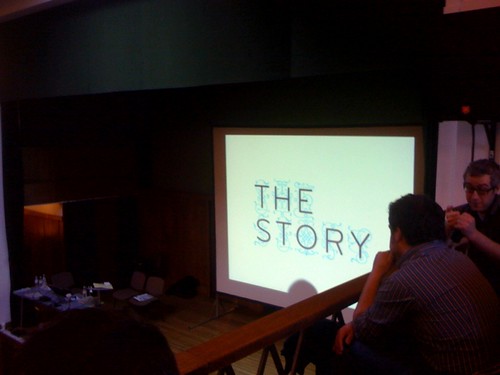 So Matt Locke's The Story happened last week. It was really good. About 400 people filled the Conway Hall to listen to people tell their stories or explain how they tell their stories. Everyone listened and laughed and applauded in the right places. In the breaks everyone filed out and drank lots of coffee. Coffee breaks looked like this, in fact:
 But I won't attempt to tell you about the whole day - partly because there was so much on, each talk was so different from the last (and yet the whole thing hung together so well), and partly because my notes and impressions would probably make no sense. In any case, the nature of the day I'd probably have to extrapolate at length to find a "point" where a lot of the time the only point might have been to tell a good story.
So I'll concentrate on my highlights instead. Annette Mees and Tassos Stevens of You Have Found Coney told us about their immersive theatre experience, A Small Town Anywhere. "What do you call it?" I wrote in my notebook alongside their names.
Alexis Kennedy of Failbetter Games showed us the inner workings of their Echo Bazaar Twitter game. "You need an organising principle" and "Go mad and hallucinate lizards" are a couple of the notes I've put against their talk. That seems to say more than I possibly could.
What the Failbetter and Coney chaps have in common is that they are striking a deft balance between the player/participant driving the story and the interventions the storyteller needs to make to get you to where they want you to go. That choose-your-own-adventure, gaming aspect to their storytelling really appeals to me; at once brilliantly nostalgic and yet at the same time feeling a bit like the future of media (and other stuff).
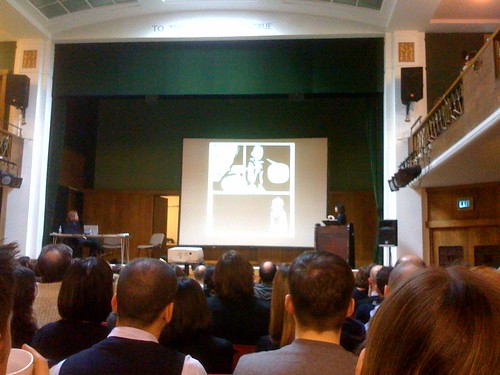
Regular readers of this blog will know of my soft spot for comics. So perhaps it's no surprise that Sydney Padua, author of the Lovelace and Babbage web comics was another highlight. Smart but self-effacing, she showed the crowd how she told stories visually as well as verbally. Her slides were great, too. I was too far away to get any real detail on my iPhone in this pic, but at least you can see that everybody's heads were pointed in the right direction.
But I won't attempt to tell you about the whole day - partly because there was so much on, each talk was so different from the last (and yet the whole thing hung together so well), and partly because my notes and impressions would probably make no sense. In any case, the nature of the day I'd probably have to extrapolate at length to find a "point" where a lot of the time the only point might have been to tell a good story.
So I'll concentrate on my highlights instead. Annette Mees and Tassos Stevens of You Have Found Coney told us about their immersive theatre experience, A Small Town Anywhere. "What do you call it?" I wrote in my notebook alongside their names.
Alexis Kennedy of Failbetter Games showed us the inner workings of their Echo Bazaar Twitter game. "You need an organising principle" and "Go mad and hallucinate lizards" are a couple of the notes I've put against their talk. That seems to say more than I possibly could.
What the Failbetter and Coney chaps have in common is that they are striking a deft balance between the player/participant driving the story and the interventions the storyteller needs to make to get you to where they want you to go. That choose-your-own-adventure, gaming aspect to their storytelling really appeals to me; at once brilliantly nostalgic and yet at the same time feeling a bit like the future of media (and other stuff).
Regular readers of this blog will know of my soft spot for comics. So perhaps it's no surprise that Sydney Padua, author of the Lovelace and Babbage web comics was another highlight. Smart but self-effacing, she showed the crowd how she told stories visually as well as verbally. Her slides were great, too. I was too far away to get any real detail on my iPhone in this pic, but at least you can see that everybody's heads were pointed in the right direction.
 But my clear favourite was Tim, who read a story about the failure of a marrriage whilst the hero attempts to fool his business partner into thinking a project with Harrison Ford was on the cards. No one seemed able to work out whether it was invented or true, or at least what the balance really was between fact and fiction. Which is exactly how I think the very best stories should be.
"Strange synchronicity" and "My moustache is a symbol of my misery" seem to sum it up perfectly, somehow. So I'll leave it there.
More eloquent and interesting observations can be found on James Bridle's, Rebecca Denton's, and Vicky Matthews's blogs.
But my clear favourite was Tim, who read a story about the failure of a marrriage whilst the hero attempts to fool his business partner into thinking a project with Harrison Ford was on the cards. No one seemed able to work out whether it was invented or true, or at least what the balance really was between fact and fiction. Which is exactly how I think the very best stories should be.
"Strange synchronicity" and "My moustache is a symbol of my misery" seem to sum it up perfectly, somehow. So I'll leave it there.
More eloquent and interesting observations can be found on James Bridle's, Rebecca Denton's, and Vicky Matthews's blogs.
Labels: A Small Town Anywhere, comics, Echo Bazaar, Failbetter Games, gaming, James Bridle, Matt Locke, Sydney Padua, the story, Tim Wright, writing, You Have Found Coney
posted by james @ 2/23/2010 02:06:00 am
0 Comments